

Like using the keys below; only I can see who you are.
On this day in 1945, the Japanese Emperor announced he had instructed his government to comply with the Potsdam Declaration and cease hostilities with, well, everyone by then.
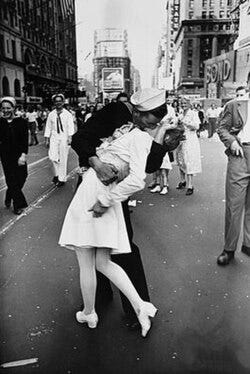
This image about sums up the reaction in the US: dental hygienist Greta Zimmer Friedman getting a big wet one from George Mendonsa, a sailor on liberty from USS The Sullivans, about to be deployed to the Pacific, who had never met before and would never meet again. The reaction in other parts of the world was less exuberant than it was in Times Square, almost certainly because the Americans had done most of the fighting in the Pacific.
The reaction in Japan was far more muted; for some, deadly. Fully half of Tokyo and most other large Japanese cities were ashes; two had been almost destroyed. Only a handful of Japanese had ever heard the voice of their Emperor until then; few could understand his court language address, but radio announcers gave colloquial Japanese translations afterwards.
It was the implications of the message that were fatal to some Japanese.
The samurai, especially the fanatical shishi steeped in the latest interpretations of bushido, had forbidden the idea of surrender for centuries. That the Emperor, without saying the word, implied surrender seemed unthinkable. Yet, Japan had been told to cooperate with the coming occupation forces. Faced with such humiliation, many top-ranking officers killed themselves, or at least tried. Tojo Hideki tried, failed and was hanged in 1947. Many common Japanese simply stopped living; their numbers are unknown. But most did their Emperor’s bidding; some did it, then killed themselves.
Still, the war went on in some places.
The announcement didn’t stop the Soviets, who still fought the dwindling Japanese resistance in Manchuria and Korea, and it didn’t prevent a handful of kamikazes from trying their luck—unsuccessfully—for another week. Fighting in Burma and the Dutch East Indies continued until mid-September, communications being so poor. In China, the KMT government and their CCP opponents still sniped at each other in the back country, and would start up in earnest by the end of the year—for them, this war was about who would run China, not what the Japanese were doing.
Who calls today what and when varies.
The date of VJ (Victory over Japan) Day, or VP (Victory in the Pacific) Day, varies with nationality and location. The Jewel Broadcast, when NHK Radio played the recording of the Showa Emperor Hirohito’s message to the world, happened at 12 noon on 15 August 1945, and took a little less than five minutes to conclude. In Moscow, it was still 14 August. However, some Americans like to observe VJ Day on 2 September, when Japan signed the Instrument of Surrender in Tokyo Bay.
Why The Samurai Lost Japan: A Study in Miscalculation and Folly
Japan attacked the West, knowing this day would come if the US and Britain didn’t give up within a year and a half. What they did not appreciate was what the human cost would be to get there.

And Finally...
On 15 August:
1945: The Japanese surrender is announced in Japan and most Western capitals. As it is still 14 August in Moscow, their VJ Day is early, but far more muted than their Victory Day over Germany, 9 May.
1945: The Kyūjō Incident ends in the morning with an unclear number of casualties (somewhere between 30 and 300) all around Japan, but mostly in Tokyo, where Japanese soldiers tried to destroy the recording of the Emperor’s voice.
And today is CHAUVIN DAY, celebrating a French soldier who may or may not have existed, but we observe his day on Napoleon Bonaparte’s 1769 birthday, which is also observed today. Chauvin, according to the stories, was a soldier entirely, blindly devoted to his Emperor, and is the source of the term “chauvinist.”