

Like using the keys below; only I can see who you are.
Imagine a world for just a movement where there was no such thing as a lie and everything everyone said is the truth.
Not hard to do, really…or is it? In this world, there’s no such thing as fiction; there’s no question that could go unanswered because no one makes anything up and, most importantly, no one seeks answers. So there’s no humor, no satire, no religion…yeah, no religion because this world only believes what it sees, feels, knows. Bear with me, Christians and other believers, because I’m trying to make a point.
There’s this movie…
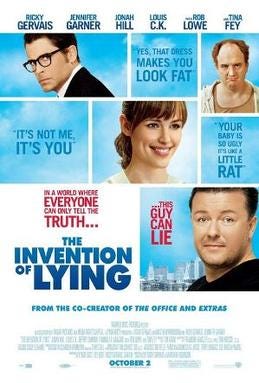
Released in 2009, The Invention of Lying (Ricky Gervais, Dan Lin, Lynda Obst, Oly Obst) and distributed by Warner Brothers is a quirky semi-comedy film in a modern setting. The storyline has the lead character, a "screenwriter," Mark (played by Ricky Gervais), who got fired from his job because nobody wanted to read about the 13th Century’s Black Plague. Since there's no fiction, and someone else has already claimed all the other, better subjects for narrative films, that’s the topic he’s stuck with. There are no actors in this world because no one knows they can impersonate someone else. So movies are just somebody telling unembellished stories of the past. But Mark gets canned for having lousy ratings.
In a time of deceit, telling the truth is a revolutionary act.
Eric Blair/George Orwell
In a time of truth, can there be revolution?
Mark needs to pay his rent because the landlord knows they fired him. So he goes to the bank and says he needs $800. The teller says he’s only got $300 in his account. Mark says, “but there’s at least $800 in there.” Now, there’s no lying in this world, so the teller says, “oh, our mistake; here,” and hands him the money. Now, he has no name for what he just did because there is no word for “truth,” either. The very concept of falsehood doesn’t exist here, so he just picks up his money, walks away and pays his rent.
Truthiness: the belief that something is true because of preexisting biases, even when directly contradicted by facts
This world is truthiness on steroids.
Only Mark doesn’t know what to call what he did because there’s no opposite. He tests this new concept of not-truth on a woman who passes him in the street (Stephanie March) uttering a mild insult. Mark says, “we have to have sex because the world is ending!” The next scene is in a hot-sheet motel where she’s entirely willing because, after all, the world is ending! Mark fakes a phone call from NASA that tells him the world is not ending, and the woman, relieved, insults him again and leaves. She doesn’t ask how NASA would even know why this random guy on the street would have such information, let alone how they would know where he was at that moment because there is no such thing as a lie in this reality.
The best jokes are dangerous, and dangerous because they are in some way truthful.
Kurt Vonnegut
Getting a job by lying.
Mark comes up with a “manuscript” he discovers about an alien invasion in the 13th Century, brings it to his former boss (Jeffery Tambor) and, naturally, gets his job back based on this lie. Mark declares that his movie will be the greatest story ever told and, of course, everyone nods in agreement because only Mark knows how to lie and becomes quite wealthy because he can just walk into the bank and say he has money there, and voila! He redirects the attention of the croupier at the casino and moves his bets around before he tells the floor boss his slot machine hit but didn’t produce his money and he gets paid off. When his mother was dying, Mark invented Heaven to make her and everyone around her feel better as she passed. This invention becomes widely known and, of course, believed. Mark invents the concepts of good and evil (since everything is true, there can be no good or evil except what someone says is good or evil) and a Man in the Sky who controls everything that he documents in ten rules on two pizza boxes. Really.
It is a comedy, after all, but in its way, it’s also a tragedy.
You can see where this is going. While Mark reads his rules in front of a vast audience and the media, they ask questions like, “how many bad things will keep me out of Heaven?” and “what happens to my mansion in Heaven when I go to live with my loved ones?” We don’t know what all the rules are because the film says it takes two hours to get through them, but we can imagine that coveting and the like is covered somewhere. The film turns into a get-the-girl (Jennifer Garner) romance where the rival (Rob Lowe) loses out at the altar, and we fade into the happy-ever-after and two kids, both of whom can lie, for Mark and his love interest.
What does lying tell us about truth?
The film is entertaining , and it did bank at the box office, but anyone thinking about the implications of this fantasy long enough will see the obvious holes. For one thing, what questions can there be in such a world? When everything is true, ambiguity, spin, explanations, and questions cease to exist. How can there be curiosity without questions? Without curiosity, where did all those inventions come from? Without the concept of sin or modesty, why is everyone clothed fashionably? There can be no art because images are false, and thus no fashions—and forget cameras. The cars, the TVs, the movies…none of it could exist because no one could imagine wanting, needing, or building them.
Can we have a world—a society—without curiosity and questions that are never asked because everything is already true?
Truth is the only safe ground to stand upon.
Elizabeth Cady Stanton
While the above may be true, it’s also misleading. The old joke about no naked man ever refusing anything from a naked woman—Adam and Eve—reminds us that truth and fiction are frequently subjective. Genesis tells us that the serpent gave Eve the apple of forbidden knowledge (about everything) after she bit it, who handed it to Adam, who bit it himself. God then banished both from the Garden of Eden for disobedience and for now knowing what God didn’t want them to know. Without those bites of the apple, how would we ever have “known” anything except what the God who made the garden, and the snake, and the apple, and Adam and Eve, wants us to know, which is nothing? How would anyone have ever followed Adam and Eve if they didn’t know the “sin” of procreation?
God in this reading sounds like an earthly dictator who only wanted two subjects.
OK, the creators of the Garden of Eden story had to have a mechanism for their narrative to move along, but that mechanism raises as many questions as it answers. The obvious plot hole in Invention of Lying is that the people still have questions, but they’re all directed at other people, not the natural world or the nature of the historical record, even the “record” Mark “discovers.” The script for the film grew from a skit the writer created about two people on a date who could not lie. Funny, no doubt, but expanded into a film, it has a tendency to reach into the absurd and avoids the nature of technological development and the historical profession.
No technology came about from a continuous string of successes.
Many failures occurred along the way, and documentation exists for them. But inventors need patrons, and in a world where there are no lies, progress has to be absolute. Many inventors sugar-coated their less-than-stellar results (and still do) until they finally succeeded. So did explorers and historians; they still do. Those old maps with monsters in the margins and exotic-looking people in those barely mapped parts; think they’re there? How many legends do we accept as historical fact? It’s not just politicians, pundits, advertisers, journalists, and “spokespersons” who lie; it’s just about everyone who needs to create a narrative to please or placate an audience or benefactor.
Scholars rely on accurate documents.
Great idea, but are they all accurate? In The Invention of Lying, people accept Mark’s “manuscript” as true since no false documents exist in that world. As a movie, it works to entertain. But in real life, do we take treasure troves such as the Epstein files as absolute truth because, well, we want all those people to be discredited? How about the Steele Dossier? Hunter’s Laptop? Are all documents in all archives and attics and drawers, and steamer trunks true just because they’re old? Any archivist or researcher will admit that forgeries abound, and locating them can be a perilous business because reputations are at stake and, sometimes, so is the historical record.
Lying says as much about us as truth does.
The Past Not Taken: Three Novellas
Some lies are defensive; some are offensive; some are just lies. Imagine a prestigious archive potentially half-full of forged documents, some of which can change the nature of the record in radical and dangerous ways, and half-full of helpful and reliable documents. How would a budding scholar, whose life is half-a-lie, work with those documents? This is how history books are written.

And Finally...
On 25 April:
1644: The last Ming Emperor, Chongzhen, hangs himself on the manmade Coal Hill/Jing Mountain outside of Beijing, China. Rebel forces under Li Zicheng had breached the city walls days before, and the Ming coffers were empty. Chongzhen is one of five Chinese emperors (of nearly 2,000) known to have committed suicide.
1953: Francis Crick’s and James Watson’s double helix DNA model is published in Nature Magazine, London, England. The model explained how genetic information stores and copies itself, earning Watson and Crick the Nobel Prize in medicine in 1962.
And today is ANZAC DAY, commemorating the day in 1915 when the Anglo-French-Australian-New Zealand landings began WWI’s ill-fated Gallipoli campaign in Turkey. People Down Under mark the day as a national day of commemoration, and it is best known for the participation of the Australia/New Zealand forces, collectively called ANZACs.
I've never heard of The Invention of Lying. I'm going to have to watch.
I've heard there's a new movie in the works, about politicians in DC, called The Invention of Honesty.
But seriously, there's a great movie with a similar theme, called Interstate 60. It's not deep, but it makes you think. And fun to watch.