

Like using the keys below; only I can see who you are.
There were several events and phenomena in Japan’s history that supplied ample fuel to a simmering fire that seemed to have been burning in the minds of much of the military and naval leadership of Japan before 1941. While much of Japan was quietly intent on merely surviving, the dominant social group in the archipelago was constantly trying to either stay in charge or justify having been in charge. This essay is the last that visits the most important elements of samurai rage against the West and their own subjects, and their constant fear of being overthrown or even contradicted. As shown by the various “insults” and momentous events in Japan over the centuries, the formation of movements and societies and the ensuing incidents happened all too easily. Too, Japan and the Japanese were apparently masters at holding a grudge.
As of December 1939, the number of men deployed to China had reached 850,000; Japan’s population hovered just above 70 million, meaning over 1% of Japanese were fighting in China—about a third of Japan’s military strength. Japanese casualties up to 1941 exceeded 185,000 killed and 325,000 wounded. The body count on the China side was orders of magnitude greater. The China Incident had become Japan’s largest-scale war in history to that point, with the largest number of victims. Even having sent so many soldiers and sacrificing so many victims, Japan could still not win that war.
Japan, by then, saw this war as more than a dispute between China and itself; it was a conflict resolvable only through global political tectonic shifts. The war in Europe and Germany’s rapid string of victories created the sense of such a shift. To take advantage of the excellent opportunity represented by that shift, and to use it to resolve the China Incident, the samurai focused on Southeast Asia, where Western colonies and easier access to the Southern Area lay.
While they agreed on their racial supremacy, neither the IJA nor the IJN could agree on anything else. Beginning in 1937, the Imperial General Headquarters-Government Liaison Conference met regularly to help integrate the decisions and needs of the military with the resources and policies of the rest of the government. But although each conference should have made joint plans between the IJA and the IJN, more agenda items concerned material allocations than strategy. This body met fifty-six times between 18 April and 4 December 1941, but the best they could come up with were “opinions” that were often wildly divergent between the IJA and the IJN. At the end of one conference in 1941, one senior IJA officer flatly declared:
…so long as the navy failed to declare unequivocally that there was no chance of victory [against the United States], the army saw no reason to concern itself with the problem [of confronting the US].
According to several junior officers, as the China war went on and Japan’s resource situation grew worse, these meetings increasingly took on an air of bizarre unreality. There was a pervasive feeling within the conference that the fate of Japan was in the hands of the gods. Even at these supposedly “joint” meetings, the two branches didn’t share the intelligence they had, or the plans they had already made. [1]
Many in Japan wanted to believe that the Americans would not fight. Most Japanese had convinced themselves that America was soft, decadent, peace loving and, most significantly, totally unprepared for war, materially and psychologically. But Yamamoto Isoroku famously warned that he could “run wild” for 6 months to a year, but if the war continued beyond that, it would go badly for Japan. Yamamoto, a constant naysayer of the Fleet Faction’s plans, was ignored and kept far away from Tokyo as Commander of the Combined Fleet, in fear for his life.
When the IJA settled on a course of action to eliminate Western support of the Chinese once and for all and gain the resources they needed to survive, IJA planners worked closely with the IJN to move its troops to faraway islands and support them. But this plan came at a cost: the IJA needed steel and oil that cut into the IJN’s allocations. The IJN ended up bargaining with the IJA over resources so that they would have the ground muscle to grab Southeast Asia and the East Indies.
That the Pacific War began in 1941 and not 1938 was only a matter of timing, not of policy, or force strength, or German aggression (though that had an influence), or even economics. It was simply a matter of both military branches realizing that after the last American sanctions, the nation would grind to a halt within a calendar year.
The Fifth Imperial National Conference, concluding on 2 July 1941, spelled out what the country was going to be doing—creating the Greater East Asia Co-Prosperity Sphere and world peace—for the foreseeable future, but it was unclear as to just how. Indeed, the very last paragraph of the Summary states that “Concrete plans covering this program will be drawn up separately.” While it spoke of “effecting a settlement of the China Incident,” mentions the “Soviet question,” and casually refers to the possibility of a war with Great Britain and America, it names no state as the primary matter of interest.
Given the geography that Japanese plans encompassed, there were no good choices for a trans-hemisphere offensive other than to delay it long enough to build up a much larger merchant fleet. That would have taken at least a decade, given Japan’s shipbuilding capacity. Buying ships, because of the war in Europe that started in 1939, would have been too expensive. But without oil, there would have been no Japanese industry or military by late 1942, and that was less than palatable. So was born the Pearl Harbor attack and everything else that kicked off in December 1941, on which the hopes of the samurai leadership depended a great deal.
On 12 December 1941, the day after Germany and Italy declared war on the United States and the US declared war back at them, Radio Tokyo severely intoned that the four-year-old China Incident and the new conflict against the West was to be referred to as the Greater East Asia War. Since it was Japan’s natural place to lead all Pacific Basin peoples, plus the struggle for the liberation of Asia from the West—plus the conquest of everything from the Rocky Mountains to Madagascar to the Arctic Ocean to Tasmania being only a matter of time—consolidating both wars into one large conflict only made sense. The then-newer term for the global conflict, World War Two, made no sense in a Japanese context.
In the distance of history, Japanese planning for 1941 looks more like staff academy exercises without limits than rational outlines with contingencies for the unexpected. Samurai strategy for the first months of the war wasn’t a strategy at all, but an optimistic and aggressive plan developed and implemented without regard for logistical constraints, intelligence on the enemy’s capabilities, or consideration of any more than one course of enemy action: The West simply had to give up quickly.
And Japan had no Plan B.
Epilogue
On 11 December 1941, the same day as the German declaration of war against the United States and the Italian declaration, representatives of Germany, Japan and Italy signed an agreement, already hammered out on 8 December, barring any separate peace with the United States or Britain in partial obedience to the terms of the Tripartite Pact. In response, on 1 January 1942, the US, Britain, and representatives of 45 other governments signed the Declaration of the United Nations in Washington, DC, pledging the same thing.
Italy surrendered on 3 September 1943; Germany on 8 May 1945.
By 1 August 1945, even the most fervent samurai knew Japan’s war was doomed. Cities in ashes; people starving; flyers boiling pine nuts for aviation fuel. Yet, there were still enough shishi fanatics around the bastions of power to make discussing surrender dangerous. The fall before, an unofficial peace effort in Europe had tried to get even recognition from Tokyo, but could not. Though the record is unclear, one can infer that Tokyo was too frightened to answer clearly.
The only response to America’s repeated broadcast entreaties had been “stop shooting and we’ll talk.” The samurai, their rage over centuries of perceived insults from the entire world still boiling, would rather have seen Japan die than dishonor themselves in surrender.
On the night of 13-14 August, with Hiroshima and Nagasaki destroyed by single weapons, the Showa Emperor had had enough. He instructed his government to accept the Potsdam Declaration and announced his intention to go on the radio to say as much to his people and the world.
The Kyujo Incident (Kyujo Jiken) that followed was a failed coup d’état to stop the broadcast and place the Showa under house arrest. On the evening of 14 August, up to 1,000 IJA officers and men of the Staff Office of the Ministry of War and the 1st Imperial Guard Division raided the Imperial Palace to destroy the recordings of the Emperor’s speech, but someone had already removed them.
The leading plotter, Hatanaka Kenji, hoped that simply occupying the palace and starting a rebellion would inspire the rest of the IJA to quash any thought of surrender. This notion gave him the blind optimism to move ahead with the plan, despite having little support. After hours of frustration, after murdering Takeshi Mori, commanding the Guards Division, Tanaka Shizuichi, who succeeded Takeshi, berated Hatanaka and co-conspirator Shiizaki Jiro into giving up the coup. They did and killed themselves hours later.
Somewhere between 30 and 300 people died in this plot and in scores of other uprisings all across Japan. Because of their failure to convince any other IJA units or members to join their plots, many of the participants committed suicide; most survivors ended their lives in prison.
The Jewel Recording broadcast, announcing to the world that the Showa had had enough and took more control of his country than any of his ancestors, started at noon Tokyo time on 15 August.
The last of the shishi died ignoble deaths either at the hands of their countrymen or at their own hands; some as they heard the voice of their Emperor for the first time. Their anger, fear, and frustration simply could not tolerate their lives any longer. Their deaths changed nothing, but their lives had changed the world.
This was the Showa Restoration, brief though it was. Unlike his grandfather’s hurried reading of the Charter Oath, the Showa Emperor Hirohito knew exactly what he was doing—saving millions of lives and Japan from the rage and fear of the samurai.
[1] Tojo didn’t know the specifics of the Pearl Harbor operation until 1945, when one of his interrogators filled him in.
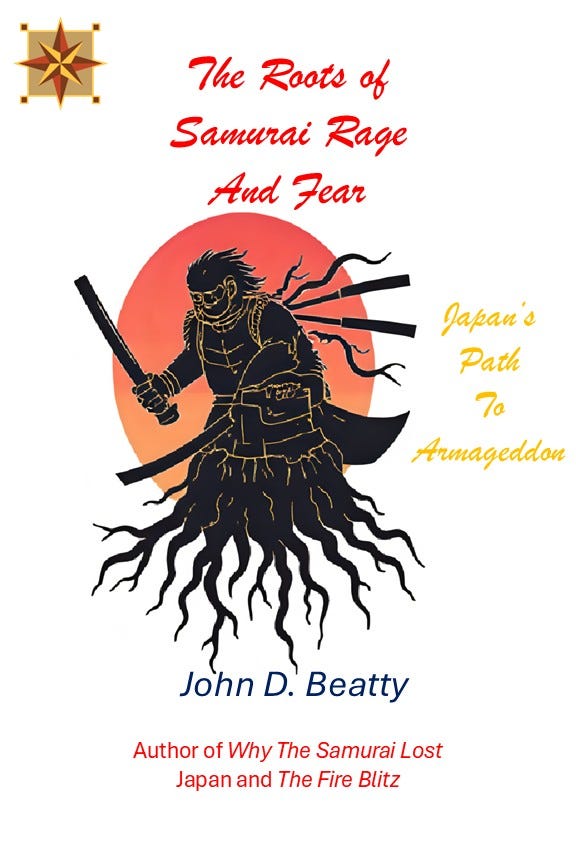
Roots of Samurai Rage And Fear: Japan’s Road To Armageddon
This book will be published on 7 December 2026! Japan’s long path to near annihilation was paved with the best of medieval intentions, and might have resulted in the “glorious” death many of the samurai desired, regrettably along with everything else Japanese.
And Finally...
On 1 August:
1794: The Whiskey Rebellion begins in western Pennsylvania, triggered after the Washington government imposed an excise tax on distilled spirits. Falling, the rebels believed, excessively on rural farmers, the rebellion lasted two years, and federally raised militias put them down; a demonstration of national resolve. Combined fatalities were less than fifty, mostly to sickness.
1815: Richard Henry Dana is born in Cambridge, Massachussets. An attorney best known for his 1840 memoir Two Years Before the Mast, which described his voyages from Massachusetts to California and back aboard two cargo schooners and the brutal treatment and conditions aboard those ships.
And today is WOMAN ASTRONOMERS DAY, observing the birth of Maria Mitchell on this day in 1818 in Nantucket, Massachusetts. Mitchell was the first internationally known woman to work as both a professional astronomer and a professor of astronomy, and the first woman elected Fellow of the American Academy of Arts and Sciences and the American Association for the Advancement of Science. In 1847, she discovered a comet she named 1847 VI (later known as Miss Mitchell’s Comet or C/1847 T1) winning a gold medal presented to her by Christian VIII of Denmark in 1848.